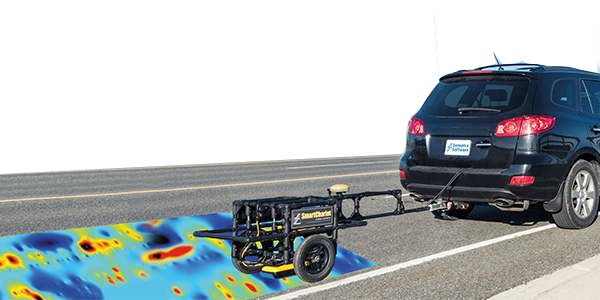
Ground Penetrating Radar (GPR) is a geophysical method that
uses radar pulses to image the subsurface. It is a non-destructive testing
technique that can be used for various applications, including archaeology,
environmental studies, geology, and civil engineering. Here are some key
aspects of Ground Penetrating Radar:
1. Principle:
·
GPR works on the principle of sending
electromagnetic pulses into the ground and recording the time it takes for the
signals to bounce back after interacting with subsurface materials.
·
Different materials have different electrical
properties, which affect the reflection and transmission of the radar signals.
These properties allow GPR to distinguish between different subsurface layers.
2. Components:
- Antenna/Transducer:
Emits and receives radar signals.
- Control Unit:
Manages the operation of the radar system.
- Display Unit:
Shows the interpreted radar data in
real-time.
3. Applications:
- Geology:
GPR is used to study the composition and
structure of the Earth's subsurface.
- Archaeology:
It helps in detecting buried artifacts,
structures, and archaeological features without excavation.
- Civil Engineering:
GPR is employed to locate utilities, assess
pavement conditions, and investigate the condition of structures.
- Environmental Studies:
GPR is used to study soil composition,
groundwater levels, and contamination.
4. Depth and Resolution:
- The depth of penetration depends on various factors, including the frequency of the radar signal and the properties of the subsurface materials.
- Higher frequencies provide better resolution but have limited penetration, while lower frequencies penetrate deeper but have lower resolution.
- GPR data is displayed in the form of radargrams or profiles, where reflections represent subsurface features.
- Trained professionals analyze these profiles to interpret the composition and structure of the subsurface.
6. Challenges:
- GPR performance can be influenced by factors like soil moisture, conductivity, and the presence of metallic or conductive objects.
- Interpretation of GPR data requires expertise, and false positives or negatives can occur.
7. Advancements:
·
Ongoing research and development are improving
GPR technology, leading to better resolution, increased depth penetration, and
more accurate interpretation.
In summary, Ground Penetrating Radar is a valuable tool in
various fields for non-destructive subsurface investigation, providing valuable
information without the need for excavation.